The Case for On-Premises AI in Strata Governance.
A US government directive suspended a frontier AI model with 90 minutes’ notice. For Australian strata operators, the implications go well beyond geopolitics.
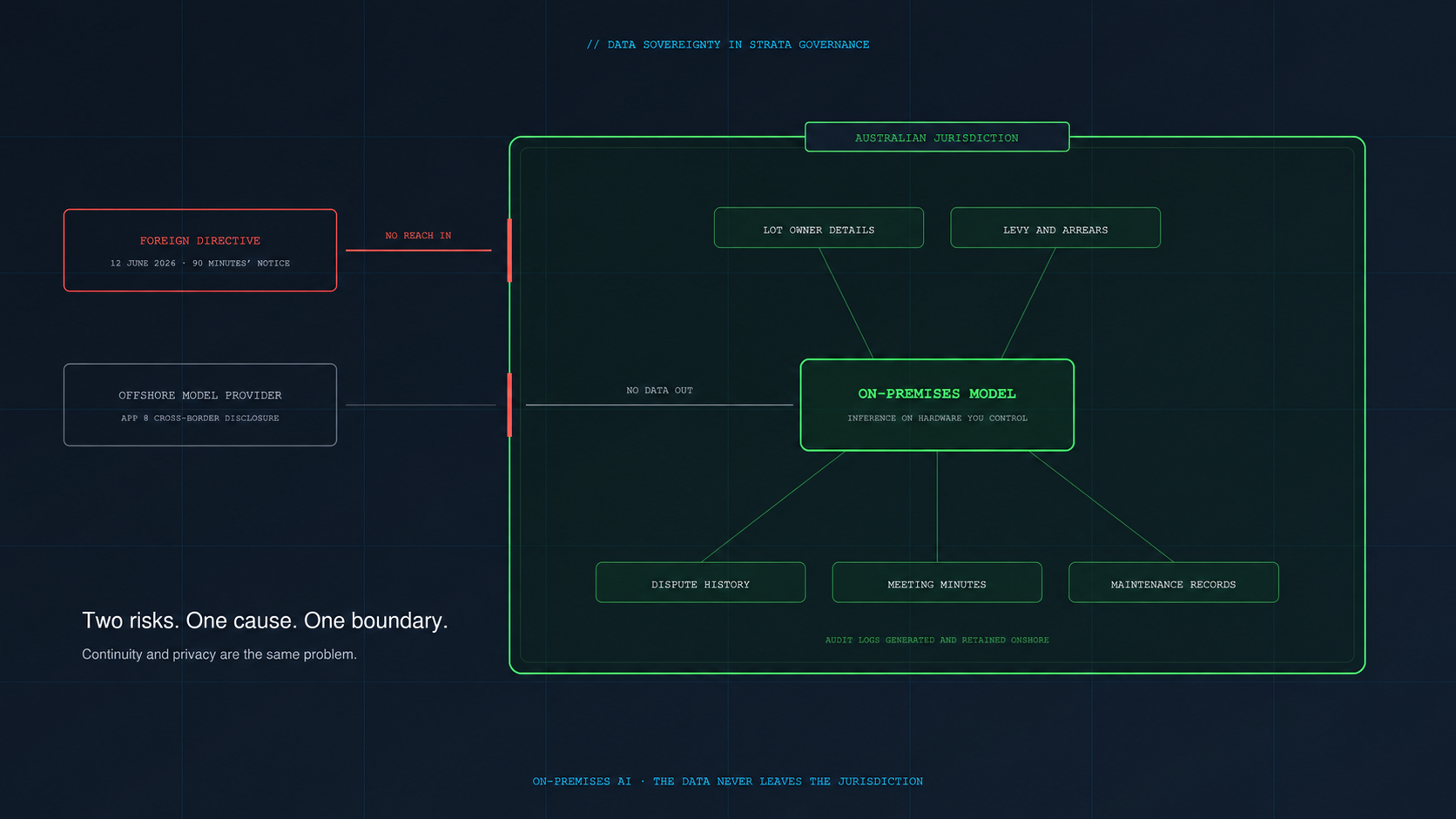
On 12 June 2026, Anthropic received a letter from the US Department of Commerce. The letter informed the company that the government had issued an export control directive suspending all access to its two newest frontier models, Fable 5 and Mythos 5, for any foreign national anywhere in the world. To comply, Anthropic disabled access for all customers globally. The shutdown took effect with approximately 90 minutes’ notice.
The Wall Street Journal described the episode as “one of the most powerful examples yet of US government intervention in the AI race.” Access was eventually restored on 30 June, after Anthropic worked with the Commerce Department to satisfy its requirements. The models had been offline for over two weeks.
The restoration is not the point. It’s the vulnerability it exposed. A single regulatory decision by a foreign government, triggered by concerns that had nothing to do with Australian users, removed access to a platform that hundreds of millions of people worldwide had integrated into their workflows. Those users had no notice, no alternative, and no recourse.
For strata operators in Australia, this incident is worth reading carefully. The questions it raises are not hypothetical.
What this means for strata governance specifically
Strata governance is not a general-purpose enterprise function. It is a regulated, compliance-sensitive discipline that sits at the intersection of property law, financial stewardship, and community trust. Strata managers and committees hold some of the most sensitive information in Australian property: lot owner contact details, levy and financial records, dispute histories, legal correspondence, maintenance records, and meeting minutes going back years.
That information does not belong to the scheme in isolation. It belongs, in a legal sense, to the lot owners whose lives and investments it describes. The obligations that flow from holding it are real and enforceable.
AI is already embedded in strata operations. Meeting transcript summarisation, correspondence drafting, by-law analysis, maintenance data review: these tools are in use across the sector. In a national webinar hosted by LookUpStrata in 2026, practitioners from Strata Solve, Grace Lawyers, and SOCM confirmed that AI has entered the sector “quietly” and that the central question is no longer whether to use it, but how to use it without creating legal, privacy, and governance problems.
The Fable 5 incident adds a new dimension to that question: what happens to your operations when the cloud AI platform you depend on disappears?
The data strata schemes routinely hold and process
-
LOT OWNER DETAILSHigh sensitivityNames, contact details, lot entitlement records. Directly in scope for Privacy Act 1988 obligations.
-
LEVY RECORDSHigh sensitivityPayment histories, arrears, fund balances. Financial information about identifiable individuals.
-
DISPUTE HISTORYHigh sensitivityBy-law breach records, tribunal correspondence, mediation outcomes.
-
MEETING MINUTESMedium sensitivityCommittee and general meeting records. May contain personal information about owners.
-
MAINTENANCE RECORDSLower sensitivityGenerally not personal information unless linked to specific lot owners.
The privacy exposure most strata operators are not thinking about
When a strata manager or committee member pastes content into a cloud AI tool, that information leaves Australian jurisdiction. It is processed on infrastructure operated by an overseas entity. Under Australian Privacy Principle 8 (APP 8) of the Privacy Act 1988, any organisation that discloses personal information to an overseas recipient must take reasonable steps to ensure that recipient handles the information in accordance with the Australian Privacy Principles. The organisation disclosing the information remains accountable for any breach by the overseas recipient.
The Office of the Australian Information Commissioner’s guidance on APP 8 is direct: the framework “generally requires an APP entity to ensure that an overseas recipient will handle an individual’s personal information in accordance with the APPs, and makes the APP entity accountable if the overseas recipient mishandles the information.”
For most cloud AI platforms, obtaining that assurance in a form that satisfies APP 8 is, in practice, not possible. The vendor’s terms of service may reference compliance with European or US privacy frameworks. They rarely map to the APPs in the specific way the OAIC requires.
The Privacy and Other Legislation Amendment Act 2024 has made this exposure significantly more serious. Maximum civil penalties now reach the greater of $50 million, three times the benefit obtained, or 30 per cent of turnover. Additional amendments taking effect in December 2026 will strengthen OAIC enforcement powers further. This is not a compliance risk that can continue to be treated as theoretical.
Two risks that are now compounding
The Fable 5 suspension and the APP 8 exposure are separate risks that share a common cause: dependency on overseas-hosted AI infrastructure. Addressing one without addressing the other leaves a strata operation exposed on both fronts.
The operational continuity risk is the one that gets less attention in compliance discussions. If a platform integral to your AGM workflow, your correspondence drafting, or your levy query handling disappears overnight, with no advance notice and no clear timeline for restoration, your scheme’s ability to meet its governance obligations does not pause. AGM notice periods still run. Levy payment obligations still fall due. Dispute response timeframes do not stop.
The data sovereignty risk is the one that gets less attention in operational discussions. When a team member uses a cloud AI tool to summarise meeting minutes containing lot owner personal information, that is likely a cross-border disclosure triggering APP 8. Schemes that have not mapped their AI tool usage against their privacy obligations are almost certainly carrying undisclosed APP 8 exposure right now.
Cloud AI versus on-premises AI for strata operations
- Operational continuity subject to foreign regulatory decisions
- Platform availability dependent on US government export control policy
- Personal data processed on overseas infrastructure
- APP 8 compliance requires contractual assurance from overseas vendor
- No guaranteed data residency within Australian jurisdiction
- Vendor terms rarely map to Australian Privacy Principles
- Service disruption risk with no advance notice (as demonstrated June 2026)
- Operational continuity under your control, not a foreign government's
- No dependency on external vendor availability or policy decisions
- All data processed within your own infrastructure
- APP 8 obligations met by design, data never leaves Australian jurisdiction
- Full data residency and audit capability
- Governance framework applied at infrastructure level
- Immune to offshore platform disruption events
What on-premises AI actually means
On-premises AI in this context means deploying a large language model on infrastructure that your organisation controls, physically located in Australia, where prompts and documents are never transmitted to any overseas model provider. The model inference, the actual AI processing step, occurs on your hardware or on Australian-sovereign cloud infrastructure under a data processing agreement that gives you effective control.
This is distinct from simply using an “Australian region” deployment of a hyperscaler cloud. If the AI model inference is processed by a US-based API, the data has left Australian jurisdiction regardless of where the underlying storage is located. That distinction matters under APP 8.
A genuinely sovereign AI deployment for strata governance requires, at minimum: model inference running on hardware physically located in Australia; all prompts and documents processed locally with no transmission to overseas model providers; audit logs generated and retained within Australian jurisdiction; and a governance framework that classifies which tasks are appropriate for AI assistance and which require human judgment.
The LookUpStrata national webinar articulated a practical framework for this last point: a traffic light classification of AI use cases. Green for low-risk administrative tasks with human review. Amber for tasks that may influence decision-making, requiring documented oversight. Red for decisions affecting legal rights, financial commitments, or enforcement action, where AI should not be the decision-maker. On-premises deployment enables this framework to be enforced at the infrastructure level, not just as a policy guideline.
The question for operators to answer now
The Fable 5 incident was resolved. Access was restored. The specific disruption lasted 18 days. But the mechanism that caused it, a unilateral foreign government directive applied to a commercial platform with no notice requirement and no Australian consultation, remains in place. It can be triggered again, for Fable, for Mythos, for any other frontier model hosted by a US-headquartered provider.
For strata operators whose schemes depend on AI tools to function efficiently, the question is straightforward: is your governance capability resilient to a platform disappearing overnight? And separately: have you mapped your AI tool usage against your APP 8 obligations, and documented the steps taken to ensure each overseas vendor handles your lot owners’ personal information in accordance with the Australian Privacy Principles?
If the answer to either question is no, the infrastructure architecture is the starting point. On-premises AI addresses both risks at once. Data never leaves your jurisdiction. Platform availability is not subject to foreign policy decisions. Governance obligations are met by design.
This is general information about strata governance and privacy obligations. Consult your strata lawyer and privacy adviser for advice specific to your scheme, jurisdiction, and AI tool usage.
StrataPort
Talk to us about safely integrating AI into your strata operation
AI designed for the regulated strata management environment. Data stays in Australia. Operations stay online.