Operations
The Non-Event Close: Why Year-End Should Be a Review, Not a Rebuild
For many strata firms the financial year-end is a multi-week scramble: an audit assembled from scratch, a report of annual activities sourced from multiple disparate systems, and an AGM pack built by hand, all compressed into the weeks when senior staff should be in front of clients. For a few firms it is a non-event. The difference is not effort or headcount. It is whether the year’s operational activity, and the content that fills the notice of AGM, were recorded as they happened in a manner that supports low-touch, or better still zero-touch, compilation and distribution.
Ask anyone outside strata when the financial year ends and they will say 30 June. Ask a strata manager and the honest answer is: it depends on the scheme. Strata firms manage annual reporting and AGM cycles scheme by scheme, not against one single national year-end. The close, the assurance step, and the meeting that signs it off run from each scheme’s own financial-year anniversary, not from the national fiscal calendar.
That one fact is what makes the strata year-end harder than it looks. The close is not a single task on a single date. For each scheme it is a sequence of obligations that have to land in order, each depending on the one before it being finished cleanly. A firm of any size is therefore rarely far from a close. At almost any point in the year it is somewhere in the cycle, for part of its portfolio.
What the Close Actually Demands
Strip away the jargon and the year-end comes down to one deliverable: a complete, defensible account of the year, ready to put in front of owners. The scheme has to prepare annual financial statements covering every dollar of income and expenditure and the assets and liabilities at year-end, and then present them, with the coming year’s budget and fees, at the annual general meeting.
Two things make that heavier than it sounds. First, the assurance step scales with the size of the scheme. In some jurisdictions the larger schemes must have their statements independently audited, the mid-sized independently reviewed, and the smaller left to resolve on either. Either way, an outside professional has to be handed a clean, complete file, and handed it early. Second, the meeting is not only about the numbers. The same notice has to carry the reports on maintenance and the year’s works, the manager and committee reports, insurance, and the proposed budget, sent to every owner with sufficient lead time to satisfy local jurisdictional requirements.
None of it is optional, and the meeting cannot simply be deferred. The gap between one annual general meeting and the next is governed by jurisdictional legislative controls.
Every jurisdiction writes its own version of these obligations into law, and the detail differs from one to the next. To make the shape concrete, take a single example. In Victoria, the year-end obligation scales with the size of the scheme: the larger the scheme, the heavier the close. The principle travels well beyond any one jurisdiction; the specific tiers and thresholds below are Victoria’s own.
The Year-End Obligation Scales With the Scheme: a Victorian Example
-
TIER 1More than 100 lotsAnnual financial statements prepared to the prescribed accounting standards and independently AUDITED by a qualified accountant after year-end. A maintenance plan and maintenance fund are mandatory. The heaviest year-end in the framework.An external audit every year, on a file that has to be complete before the auditor starts.
-
TIER 251 to 100 lotsAnnual financial statements independently REVIEWED by a qualified accountant after year-end (the meeting may resolve to a full audit instead). A maintenance plan and maintenance fund are mandatory.An independent review every year, plus the maintenance plan obligations.
-
TIERS 3 TO 550 lots or fewerStatements still prepared and presented at the meeting; an audit or review is optional and decided by resolution. Lighter on paper, but the same accounts, budget, reports and notice still have to be produced and sent.No mandatory assurance, yet the year-end pack still has to be compiled and distributed.
Why the Close Clusters
Schemes set their own year-ends, but they do not spread evenly across the calendar. Many align with the 30 June fiscal cycle. Because the accounts are struck at year-end and the meeting that presents them follows soon after, that makes July to September the peak season: the heaviest stretch of the strata year, when a single firm can be closing the books, shepherding audits and reviews, and running annual meetings across much of its portfolio at once, on top of the steady stream of off-cycle schemes whose anniversaries fall in every other month.
That concentration is what breaks the manual model. The cost is not the work on any one scheme. It is that so much of it lands together, in the very weeks when the same senior people are also chairing the meetings. This is the Efficiency Ceiling we wrote about earlier in the year, made visible on the calendar. A firm that grows by adding lots without changing how it closes the books simply makes its own peak season harder every year.
The Two Closes
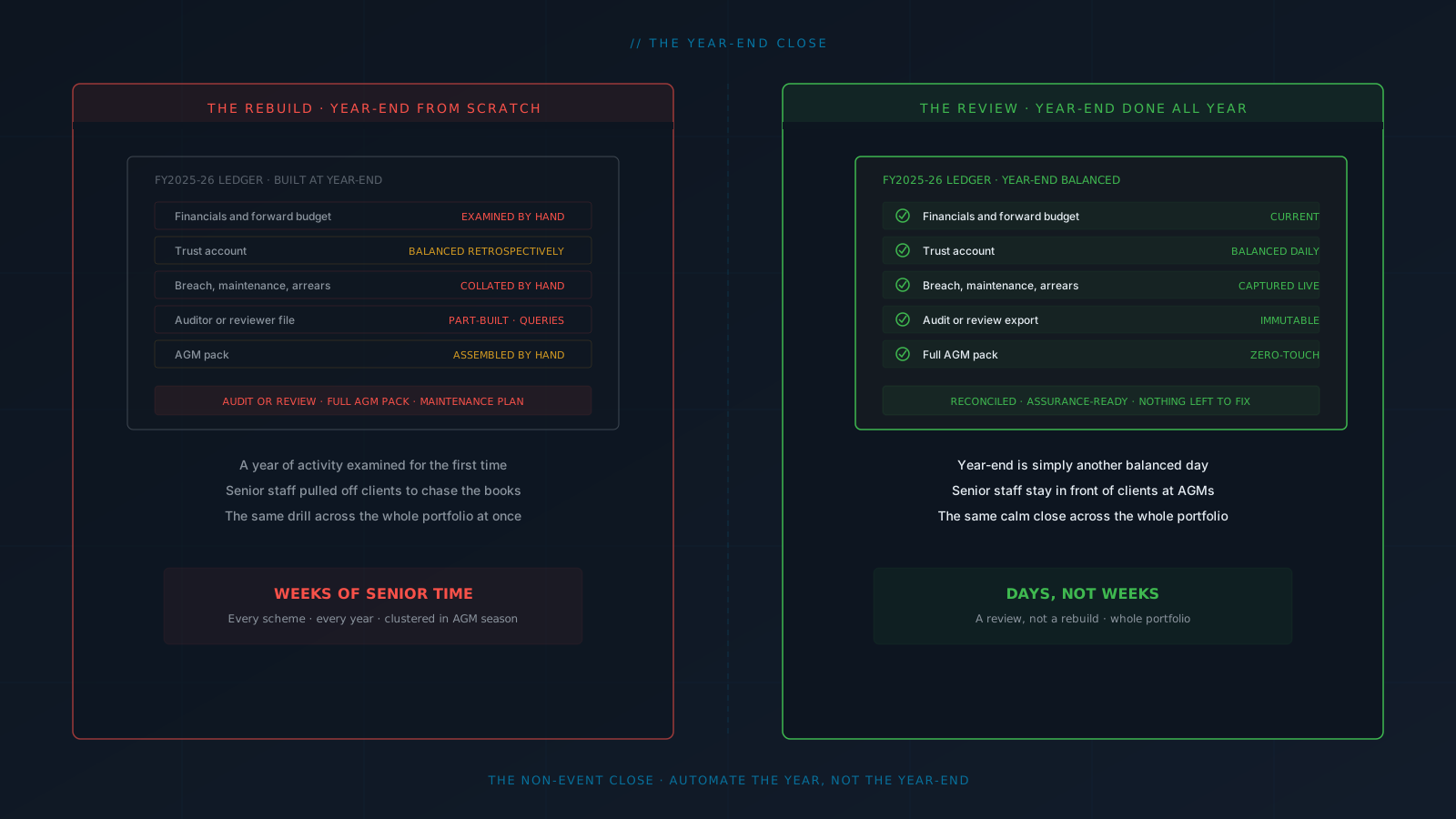
Two firms with identical portfolios can have completely different year-ends. The difference is not the effort they put in during the close. It is everything they did, or did not do, in the eleven months before it.
The Year-End Close, Two Operating Models
- A year of financials manually examined and forward budgeting recommendations manually determined
- The trust account balanced retrospectively, with discrepancies chased back across twelve months
- Breach notices, maintenance events and arrears reports independently generated and collated
- The auditor handed a part-built file and a list of open questions
- The AGM pack assembled scheme by scheme, manually
- Financials current all year, with the coming year's budget and forward recommendations drawn from the live numbers
- The trust account balanced daily, so the year-end is simply another balanced day
- Breach notices, maintenance events and arrears captured as they happen and already collated into the report
- The auditor or reviewer given a complete, structured, immutable export, every figure traceable to source
- The full AGM pack compiled and distributed zero-touch, scheme after scheme
The outcomes StrataPort delivers are not an aspiration. They are the compounding payoff of decisions made the rest of the year: daily trust balancing instead of catch-up, continuous invoice processing instead of a year-end pile, and the zero-touch AGM setup that turns the meeting pack from weeks of manual assembly into a generated artefact. The close did not get faster because anyone worked harder at year-end. It got faster because there was nothing left to fix.
Year-End Belongs to the Deterministic Engine
The 2026 temptation is to point a clever AI at the year-end mess and ask it to sort everything out. That is precisely the wrong instinct, and it is worth being blunt about why.
Levy calculations, fund balances, trust reconciliations and audited statements are not a place for probabilistic output. They have to be deterministic, reproducible and traceable: the same inputs must produce the same audited figures every time, with a structured trail the auditor or reviewer can follow line by line. This is the boundary we drew in Deterministic vs Probabilistic, and year-end is where that boundary is tested hardest. The proper role for automation at the close is not judgement. It is to have kept the numbers correct all year, so that by the time the meeting falls due there is simply nothing left to judge.
The Close Is an Orchestration Problem
A clean close also reaches well beyond the platform itself. It pulls from the trust bank for the reconciliation, from the auditor or reviewer who signs off the statements, from the insurer behind the cover that has to be confirmed at the meeting, and from the maintenance plan and valuation inputs that larger schemes are required to keep current.
The firms that close fastest are not the ones that tried to build every one of those functions in-house. They are the ones whose platform talks to all of them coherently, so the close is an act of orchestration rather than manual assembly. That is the same posture we set out in The Integration Imperative: the governance platform holds the spine, and connects to the specialists for everything else.
The Bottom Line
Year-end is not an accounting task that happens once a year. It is the readout of how the year was recorded: every breach notice, maintenance event, decision and dollar, and the content that fills the notice of AGM, either captured as it happened in a form ready to compile and distribute, or left to be reassembled by hand when the deadline arrives.
A firm whose systems recorded all of it as it went does not have a year-end problem. It has a year-end formality: the pack compiles and goes out with little or no human touch. A firm that deferred the recording does not have an accounting problem when the meeting falls due. It has an operating-model problem that was there all along, and the deadline did not create it. The deadline only made it impossible to ignore.
The work that turns the close into a non-event is not done in the close. It is done on every other day of the year.