Platform The Difference FAQ Insights Pricing Request a Briefing

Enterprise Strata Insights

Analysis, strategy and operational intelligence for enterprise strata management professionals
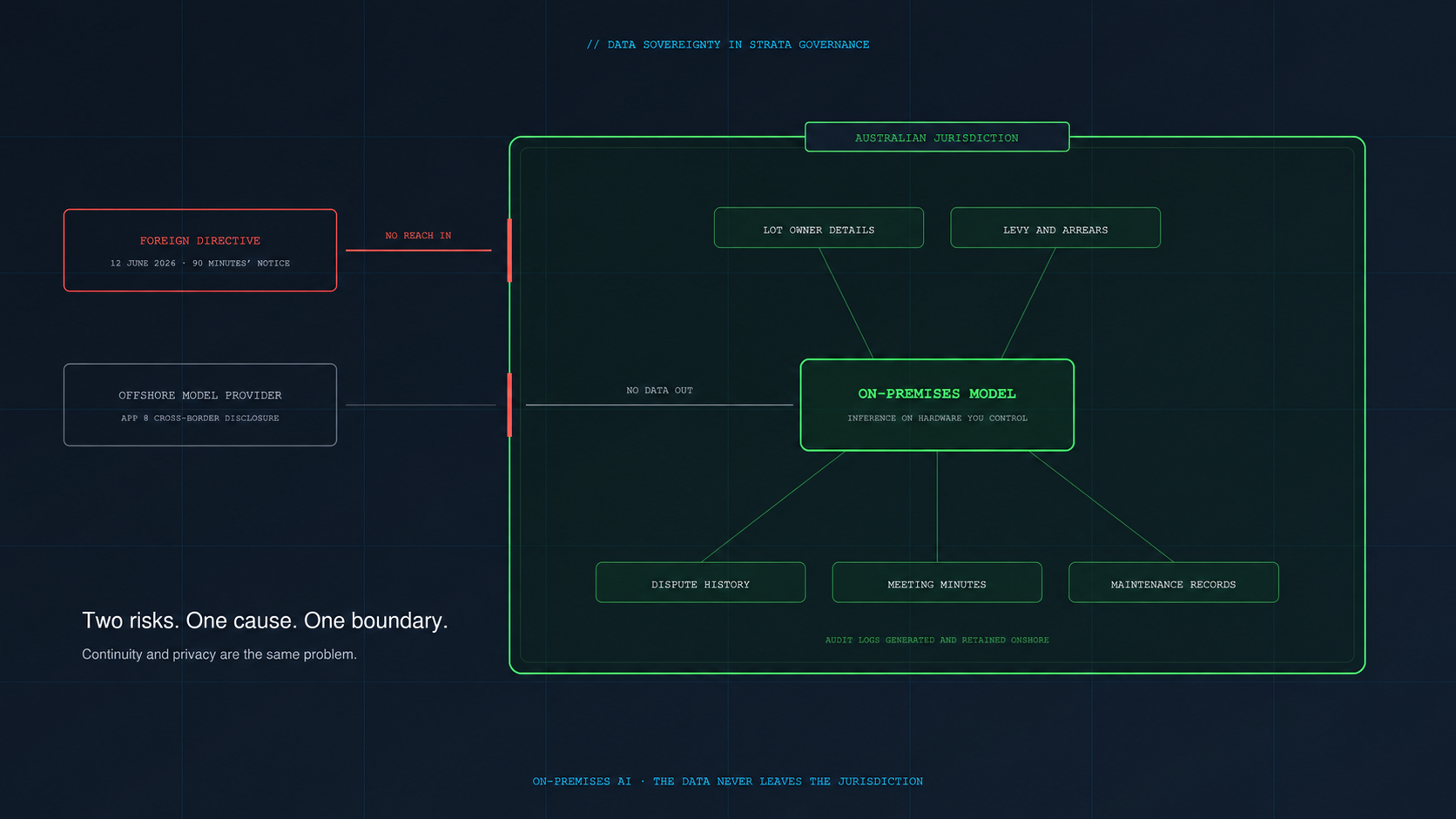
The Efficiency Ceiling
ECONOMICS February 2026 5 min

The Efficiency Ceiling: Why Linear Headcount Growth is Failing Enterprise Strata

Macquarie Bank data released last month shows mid-tier strata firms losing margin despite fee increases. Automation-driven decoupling is the only path to profitable scale.

Read
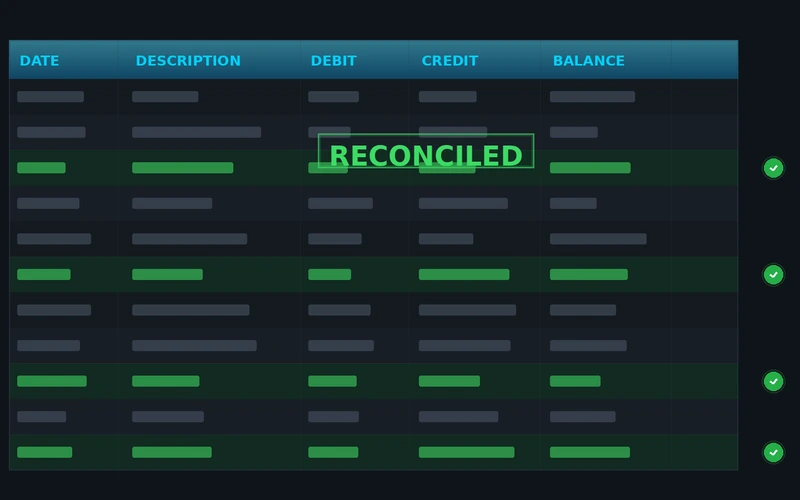
Trust Accounting Automation Playbook
COMPLIANCE February 2026 4 min

The Trust Accounting Automation Playbook: Why Daily Balancing is Just the Starting Line

For most enterprise firms, daily bank reconciliation is now standard practice. But balancing the books doesn’t mean you’ve optimised the workflow. This article explores the next level of trust accounting automation.

Read
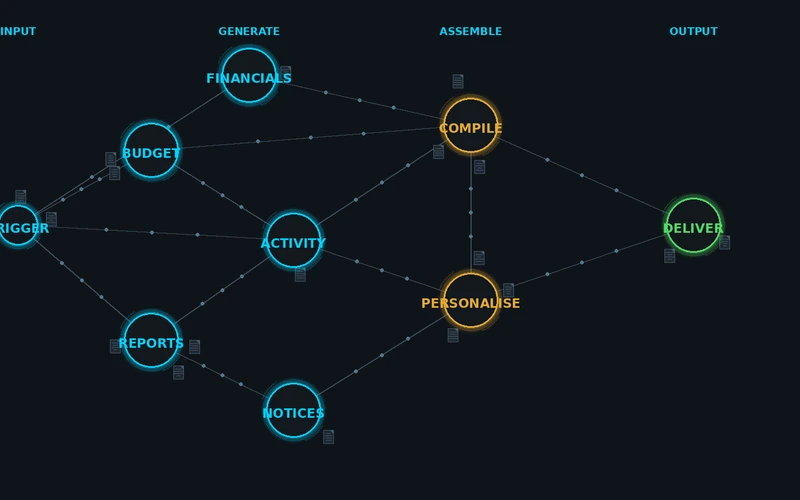
Anatomy of a Zero-Touch AGM
OPERATIONS February 2026 5 min

Anatomy of a Zero-Touch AGM: What Happens When You Press the Button

A step-by-step breakdown of how StrataPort's AGM automation generates, compiles and distributes dozens of documents without human intervention.

Read
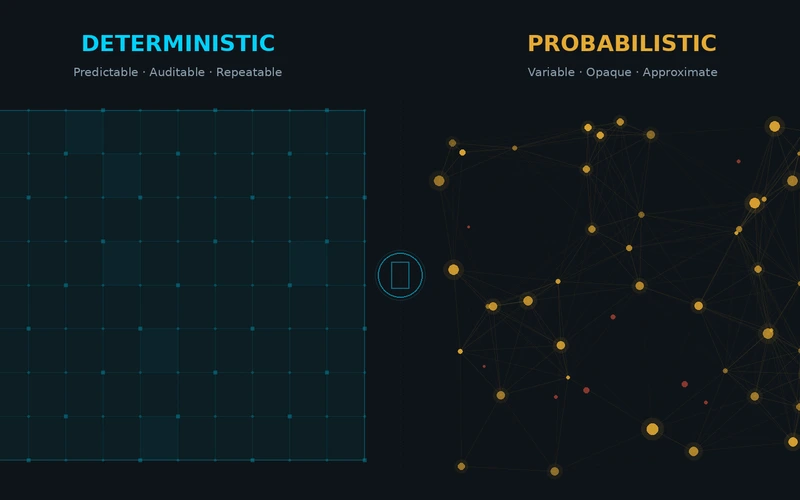
Deterministic vs Probabilistic AI in Strata
TECHNOLOGY February 2026 4 min

Deterministic vs Probabilistic: Why We Don't Put AI in the Automation Pipeline

The case for rules-based automation in trust accounting and compliance — and where AI actually belongs in the strata management stack.

Read
The Supplier Invoice Black Hole
ECONOMICS February 2026 4 min

The Supplier Invoice Black Hole: Quantifying the Hidden Cost of Manual Processing

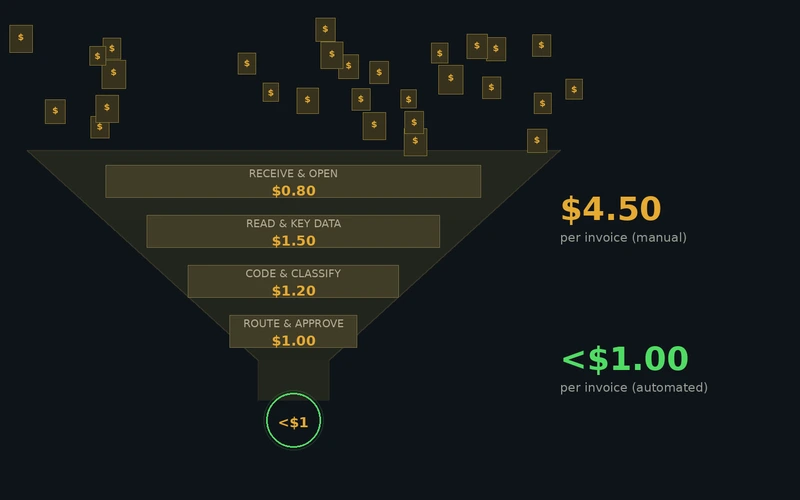
When you process 50,000 invoices a year at $4.50 each in labour, the numbers are staggering. Here's the unit economics case for API-driven automation.

Read
From Admin Manager to Growth Leader
LEADERSHIP February 2026 4 min

From Admin Manager to Growth Leader: Redefining the Strata Executive Role

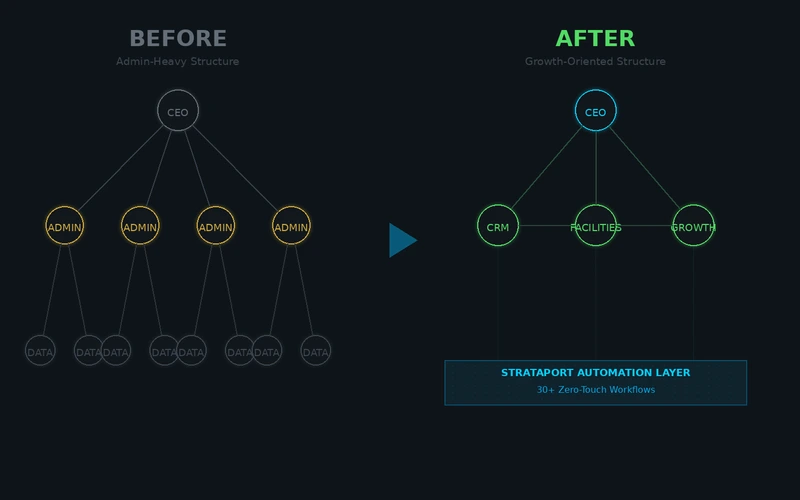
Automation isn't about replacing staff — it's about funding the client relationship and technical facilities roles that justify premium fees and prevent churn.

Read
Back to all articles

The Efficiency Ceiling: Why Linear Headcount Growth is Failing Enterprise Strata

Revenue is up, margins are down — the 2025 benchmarking data reveals a broken growth model. The only path to profitable scale is to decouple revenue growth from headcount.

The Efficiency Ceiling

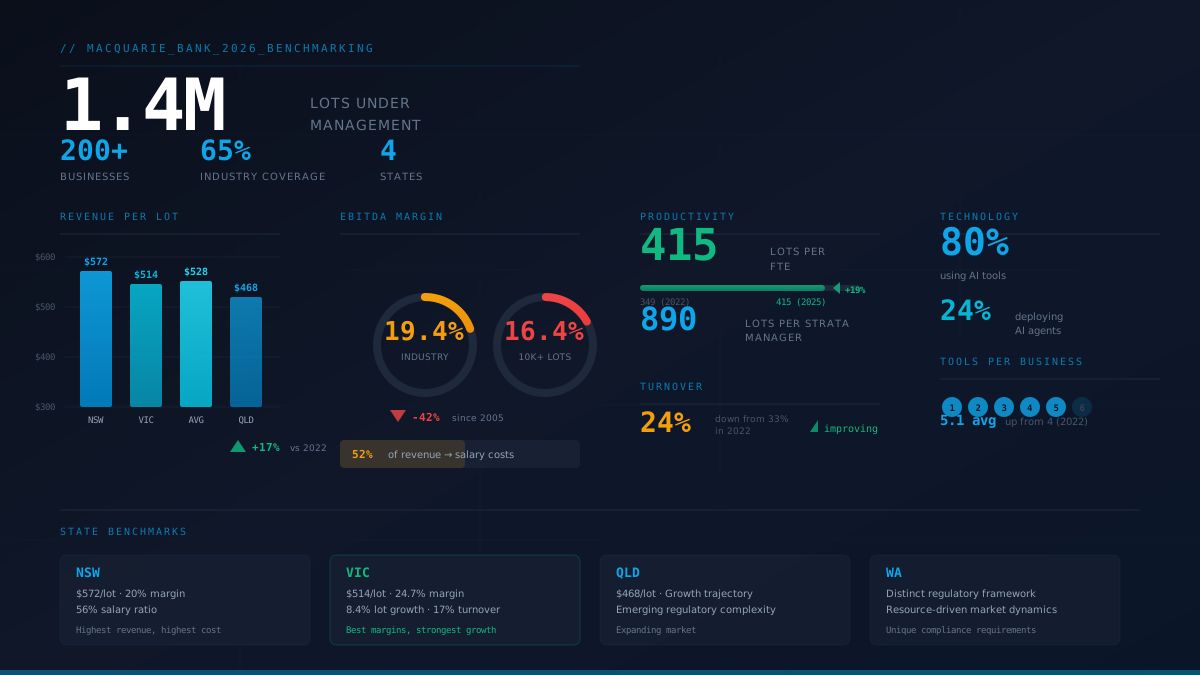
As the dust settles on the 2025 financial year, the Australian strata sector is facing a paradox. According to the Macquarie Bank Strata Benchmarking Report (released January 2026), average management fees per lot have risen by 8% over the last 12 months. On paper, the industry is booming. Yet, Net Profit Margins (NPM) for mid-tier firms have actually compressed, dropping from an average of 22% in 2023 to just 18.5% in 2025.

Where is the money going? The answer lies in the "Efficiency Ceiling."

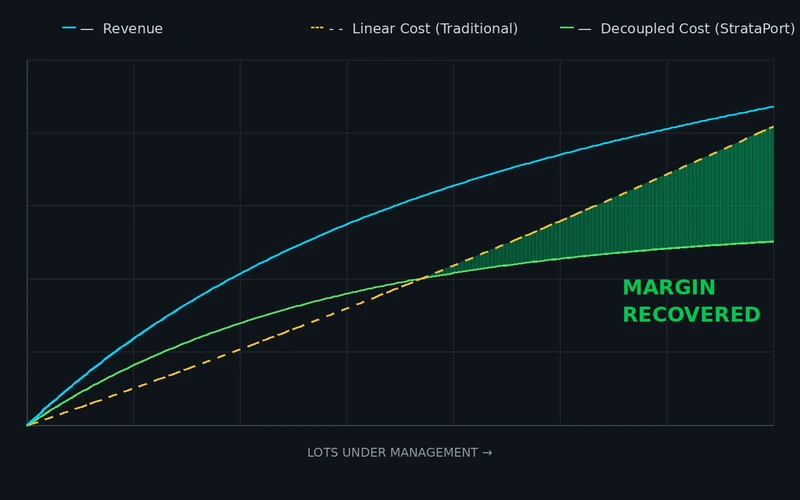
For fifty years, strata management has operated on a linear growth model: to manage 1,000 more lots, you hire 5 more managers. In a low-inflation environment, this was sustainable. In the wage climate of 2026, it is a mathematically broken model.

The "Wage Cliff" of 2026

The shortage of qualified strata managers, exacerbated by the licensing reforms of late 2024, has driven salaries to historic highs. Staff wages now consume, on average, 58.4% of total revenue for standard firms — a sharp increase from the 50–52% standard seen earlier in the decade.

When you factor in the "Compliance Tax" — the estimated 15% increase in administrative load due to the 2025 building defect and insurance transparency regulations — the cost of servicing a single lot has outpaced the fee increase.

The Linear Trap: Why Scale is Hurting You

Convention says that scale brings efficiency. In traditional strata firms, the opposite is often true. We call this the Complexity Matrix.

A portfolio of 2,000 lots is manageable with standard tools. A portfolio of 20,000 lots, however, does not just add volume; it adds friction.

If your growth strategy relies on hiring a new manager for every 200 lots gained, you are running up a down escalator.

The "Decoupling" Imperative

The defining characteristic of the "Alpha Firms" identified in the 2025 benchmarking data — those maintaining margins above 28% — is Decoupling. They have successfully severed the link between revenue growth and headcount growth.

They haven't done this by overloading their staff. They have done it by deploying an "Operational Shield," like StrataPort Plus.

How the Shield Fixes Unit Economics

StrataPort Plus attacks the 40% of volume that provides zero strategic value. Consider the lifecycle of a supplier invoice in 2026:

Supplier Invoice Processing — Unit Economics

TRADITIONAL
Received via email → Opened by human → PDF read → Data keyed into software manually → GL code selected manually → Routed for approval
Cost: $4.50 per invoice in labour time
STRATAPORT
Received via API/Email → Data extracted automatically → GL code selected based on history → ABN verified against register → Routed to manager for one-click approval
Cost: $0.08 per invoice in compute time

When applied across 50,000 annual invoices, the savings are not marginal; they are transformative. This "Robotic Back-Office" allows a firm to grow by 2,000 lots without hiring a single new administrative support staff member.

Reallocating the Surplus

The goal of StrataPort Plus is not to fire staff; it is to fund the roles that actually drive growth. By reclaiming the budget previously lost to data entry wages, enterprise firms are hiring Client Relationship Managers and Technical Facilities Managers — high-value roles that justify premium fees and prevent client churn.

The Fork in the Road

The data from 2025 is clear. The "Linear Firms" are seeing their margins eaten by wage inflation and compliance drag. The "Exponential Firms" are automating the baseline to protect their margins. In 2026, automation isn't just an efficiency play — it's a survival strategy for the P&L.

References

  1. Macquarie Bank Strata Management Benchmarking Report (2025/2026 Edition) — Data on wage-to-revenue ratios and net profit compression
  2. SCA (National) Labour Market Analysis Q1 2026 — Statistics on salary inflation and talent shortages
← PREVIOUS ARTICLE

No previous articles

This is the first article

NEXT ARTICLE →

The Trust Accounting Automation Playbook

Compliance · February 2026

Back to all articles

The Trust Accounting Automation Playbook: Why Daily Balancing is Just the Starting Line

For most enterprise firms, daily bank reconciliation is now standard practice. But balancing the books doesn’t mean you’ve optimised the workflow. This article explores the “next level” of trust accounting automation: dynamic budget uplifts, year-on-year levy adjustments, and the complex exception management required for automated penalties.

Trust Accounting Automation Playbook

In 2026, daily bank reconciliation is table stakes. If a trust accounting platform isn’t automatically importing TXN files and balancing the cash position by 9:00 AM, it is already behind. But balancing the ledger is just the baseline. The real efficiency gains — and the real profit protection — come from automating the complex, cyclical financial events that occur after the daily rec is done.

While most modern platforms can generate levies in bulk, the “setup” required to get accurate figures across hundreds of schemes is often a manual chokepoint. The ideal automation playbook moves beyond simple batch processing to handle the entire logic of scheme finance.

1. Smarter Levy Logic: It’s All in the Setup

Generating a levy notice is easy. Ensuring that notice reflects the correct budget, uplift, and entitlement liability for 500 different buildings — without checking each one manually — is hard. The ideal solution replaces manual calculation with Scheme-Level Parametric Automation.

2. The Daily Delivery Engine (With a Safety Net)

Levy generation shouldn’t be a monthly panic; it should be a daily rhythm. The optimal workflow involves generating and delivering Fee, Arrears, and Final Notices every single business day.

The Daily Levy Delivery Engine — Workflow

AM CYCLE
Portfolio scanned → Levy rules evaluated per scheme → Fee Notices, Arrears Notices & Final Notices generated automatically → Queued for review
Status: Generated & Held
VETTING WINDOW
Full working-hours gap for human oversight → Staff review, adjust, or hold specific notices → Exception flags resolved → Compliance confirmed
Safety net: Speed of automation + human oversight
PM CYCLE
Approved notices released → Delivered via email, portal & post → Ledger updated → Audit trail recorded
Status: Delivered & Reconciled

This three-phase rhythm replaces the monthly panic of batch levy generation with a daily, predictable cadence — combining the speed of automation with the safety of human oversight.

3. Protecting Revenue: Automated Fee Adjustments

One of the silent killers of agency margin is the “drift” between what was budgeted in management fees and what was actually billed. If a building’s lot count changes, or a disbursement rate is updated mid-year, manual systems often miss the catch-up billing.

Fee Variance Analysis — Automatic Revenue Protection

BUDGETED
Management fee contracted at financial year start → Based on lot count, disbursement rate & agreed schedule
Example: $48,000 annual fee ($4,000/month × 12)
ACTUAL
Amount billed across the period → May drift if lot count changed mid-year or disbursement rate was updated
Example: $44,000 billed (lot count reduced in Q2, rate not adjusted)
STRATAPORT
Variance detected at rollover → Delta calculated automatically → Adjustment invoice generated → Revenue reconciled to contract
Result: $4,000 adjustment invoice issued — zero revenue leakage

4. The LPP Challenge: Managing Exceptions

The challenge with Late Payment Penalties (LPPs) is Exception Management. Cross-referencing which lots are eligible for a penalty is a massive administrative drain. Does the lot have an active Payment Plan? Is it currently escalated to a Legal Case? Does the arrears amount fall below the scheme’s specific threshold?

The solution is an engine that handles these exceptions logically:

The Bottom Line

Daily balancing proves an agency knows where the money is. But automated logic — handling levies, fees, and penalty exceptions — proves they know how to manage it. By removing the manual friction from these complex financial cycles, agencies can manage larger portfolios with less stress and zero revenue leakage.

StrataPort v3.0 delivers every workflow and automation capability outlined above.

← PREVIOUS ARTICLE

The Efficiency Ceiling

Economics · February 2026

NEXT ARTICLE →

The Supplier Invoice Black Hole

Economics · February 2026

Back to all articles

The Supplier Invoice Black Hole: Quantifying the Hidden Cost of Manual Processing

Even in highly efficient strata firms, manually processing inbound supplier invoices costs more than most managers realise. When you process 50,000 invoices a year at $5–$7 each in data-entry labour alone, the numbers are substantial. This article breaks down the unit economics of manual AP versus API-driven automation, and explains how integrated work order systems transform invoice processing from a manual expense into a structured, data-driven workflow.

The Supplier Invoice Black Hole

In the average strata firm, the Accounts Payable (AP) function quietly absorbs enormous operational effort. Invoices arrive via email, post, and portal, creating a fragmented flow that requires human intervention before the data reaches the finance system.

Even when internal processes are highly streamlined, someone still needs to open the email or attachment, review the PDF, enter supplier details, code the GL, attach the file, and push it into workflow. That touch time is not free.

The $300,000 Problem

Industry benchmarking suggests that manual AP data-entry touch alone typically costs between $5–$7 per invoice in labour in Australia. This estimate excludes approval time and management review — it reflects only the Accounts Payable processing effort required to receive, interpret and enter invoice data into the system.

Annual AP Data-Entry Cost — Mid-Sized Strata Firm (50,000 invoices/year)

LOW ESTIMATE
50,000 invoices × $5.00 per invoice in labour time
Annual cost: $250,000
HIGH ESTIMATE
50,000 invoices × $7.00 per invoice in labour time
Annual cost: $350,000

That is a six-figure operational cost purely for moving data from PDF into software. It is important to acknowledge that many strata firms already operate efficient AP teams with structured coding rules and experienced staff. In such environments, data-entry time may sit at the lower end of the range.

However, even a well-optimised manual process cannot eliminate the fundamental reality: a human must read and re-key information that already exists in digital form.

A Broader Benchmark

For context, the Australian Taxation Office’s Peppol eInvoicing Value Assessment (prepared by Deloitte Access Economics) estimates that the total processing cost of a PDF invoice is approximately $27.67, and a paper invoice approximately $30.87. The report allocates roughly 60% of that cost to the Accounts Payable side of the transaction.

These figures include end-to-end effort — receipt, validation, review, approval and related overhead — not just data entry. Strata firms with disciplined internal workflows may sit below these broader cross-industry averages. But even if your AP touch cost is “only” $5–$7, the aggregate impact remains material.

The “Source-to-Pay” Revolution

The solution is not faster typing. It is changing the source of the data. Modern, best-of-breed strata management platforms move the industry away from “reading PDFs” to “consuming structured data.”

Work Order Integration — When a Work Order for a Valuation, BHS Report, or Maintenance job is marked “Complete” by the supplier within the platform, the system can auto-generate the supplier invoice. The data does not need to be read; it is already known.

Insurance Automation — Renewals and endorsements received via structured integration channels can update policy data automatically and pass invoice data directly to the finance system.

Revenue Event Automation — When a system applies a late payment penalty to a lot owner, it can simultaneously generate the corresponding supplier or revenue invoice for the firm — without manual re-entry.

Verification at Scale

Speed means nothing without security. Best-of-breed strata management platforms offer integration to third-party verification services (such as Eftsure) directly within the payment workflow. Before an invoice reaches the approval queue, supplier identity and bank details can be validated against national registries. This reduces fraud exposure while eliminating repetitive validation work.

The Enterprise Advantage

If manual AP touch costs $5–$7 per invoice, and API-driven automation reduces that to under $0.50 in system-level processing cost, the economics are clear.

Supplier Invoice Processing — Annual Cost Comparison (50,000 invoices)

MANUAL AP
Received via email → Opened by human → PDF reviewed → Supplier details entered → GL coded manually → File attached → Pushed to workflow
Annual cost: $250,000–$350,000 in labour
AUTOMATED
Received via API/Work Order → Data extracted automatically → GL coded from history → Supplier verified against registry → Routed for one-click approval
Annual cost: <$25,000 equivalent processing cost

That delta represents a potential six-figure productivity shift — without increasing headcount, and without signing a single new client. Automation does not make your team redundant. It removes the black hole so your team can focus on value, not transcription.

StrataPort v3.0 delivers every workflow and automation capability outlined above.

References

  1. Australian Taxation Office – eInvoicing Value Assessment (Deloitte Access Economics) — Estimated processing cost per PDF invoice: $27.67; paper invoice: $30.87; approximately 60% attributed to Accounts Payable
  2. SEEK Australia – Accounts Payable Officer salary benchmarks (used to derive labour cost per minute estimates)
  3. Glassdoor Australia – Accounts Payable Officer average salary and hourly estimates (used for wage range validation)
← PREVIOUS ARTICLE

The Trust Accounting Automation Playbook

Compliance · February 2026

NEXT ARTICLE →

Anatomy of a Zero-Touch AGM

Operations · February 2026

Back to all articles

Anatomy of a Zero-Touch AGM: What Happens When You Press the Button

The Annual General Meeting (AGM) is the central event in the annual strata management workflow. This article pulls back the curtain on StrataPort’s AGM engine, which triggers a cascade of reporting and document creation, compilation, and distribution that replaces hours of manual labour.

Anatomy of a Zero-Touch AGM

Ask any strata manager what they dread most, and the answer is often “AGM Season.” The sheer volume of documentation required to legally convene a meeting in 2026 is staggering: agendas, financials, insurance certificates, valuation reports, proxy forms, and nomination papers.

In legacy systems, compiling an AGM pack is a partial — if not fully — manual assembly job. In StrataPort it is a “Zero-Touch” computation.

Phase 1: The Automated Assembly

When you initiate an AGM in StrataPort, you aren’t just opening a template. You are triggering a logic engine.

What the AGM Engine Generates Automatically

FINANCIALS
The proposed new Budget applying building-specific uplift rules — complete with a graphic year-on-year budget vs actual expenditure comparison. The Balance Sheet as at the end of the previous financial year, including end-of-year bank account balances. A comprehensive Income/Expense report.
COMPLIANCE
Checks multiple building metrics: Is an Insurance Valuation due or was a new valuation completed? Is a BHS audit required or was a new BHS audit completed?
THE “PACK”
Pulls the Insurance Certificate, FSG, Model Rules, and previous Minutes, generates a dynamic Index, applies page numbering, and merges it all into a single, branded PDF.

Phase 2: The Meeting (Smart Data Capture)

During the meeting, StrataPort doesn’t just record text; it captures data. When you record a vote or a decision, you are updating the system’s “truth.”

Attendance — Quorum is calculated instantly based on lot entitlement liabilities including lot owner financial status.

Voting — Electronic proxies lodged pre-meeting are automatically tallied.

Financials — Adopting the budget automatically updates the levy schedule for the next year.

Phase 3: The “Post-Meeting” Cascade

This is where the magic happens. When the meeting is finalised, StrataPort executes the Post-Meeting Automation workflow.

Post-Meeting Automation Workflow

STEP 1
Minutes Distribution: Minutes are generated and sent to all owners via their preferred method (email/post).
STEP 2
Work Order Triggers: Maintenance, Valuations, BHS Audits, and Insurance Quotes, Endorsements and Renewals are automatically issued. All resolved meeting item values — such as the members elected to the committee and the scheme penalty interest parameters — are automatically updated.
STEP 3
Levy Generation: The new levy contributions are struck including pre-issues through to the next AGM, with fully automated management of adjustments for year-on-year budget fluctuations.
STEP 4
Management Fee Adjustments: Any variation in management fees due to year-on-year budget fluctuations are automatically calculated and resulting invoices issued.

The “Zero-Touch” AGM doesn’t mean the manager isn’t involved — it means the manager is involved in the meeting, not the paperwork. By automating the assembly and the follow-up, StrataPort frees the manager to focus on what matters: guiding the owners corporation through complex decisions.

StrataPort v3.0 delivers every workflow and automation capability outlined above.

← PREVIOUS ARTICLE

The Supplier Invoice Black Hole

Economics · February 2026

NEXT ARTICLE →

Deterministic vs Probabilistic

Technology · February 2026

Back to all articles

Deterministic vs Probabilistic: Why We Don’t Put AI in the Automation Pipeline

“AI” is the buzzword of 2026, but not all automation is created equal. This article explains the crucial difference between Probabilistic AI (chatbots) and Deterministic Workflows (StrataPort), and why trust accounting requires the certainty of code, not the creativity of an algorithm.

Deterministic vs Probabilistic AI in Strata

In the rush to adopt Artificial Intelligence, the technology sector has blurred the lines between two very different types of software: Probabilistic and Deterministic. Understanding the difference is critical for any Principal choosing a strata platform in 2026.

Probabilistic AI: The “Creative” Assistant

Large Language Models (like ChatGPT) are probabilistic. They predict the next word in a sentence based on probability. They are brilliant at drafting emails, summarising long documents, or suggesting wording for a motion.

This is where StrataPort uses AI — in the “Intake” and “Drafting” layers of our Operational Shield.

Deterministic Automation: The “Iron” Law

However, you cannot use probability to calculate a levy notice. You cannot use a “best guess” to reconcile a trust account. These tasks require Deterministic Automation.

Deterministic software follows rigid, “If This, Then That” logic. It produces the same result 100% of the time.

Deterministic Rules in Action

IF
The levy is 14 days overdue → Then issue a C1 Reminder
IF
The BAS figures don’t match → Then flag the transaction
IF
The Valuation Work Order is complete → Then generate the invoice

Why StrataPort Keeps Them Separate

In StrataPort we have deliberately firewalled our automation engine from our AI engine. When StrataPort runs a Daily Bank Reconciliation, it isn’t “thinking”; it is executing a mathematical proof. When it generates a Management Contract renewal, it isn’t “writing”; it is assembling validated data points.

Two Engines, One Platform

PROBABILISTIC
AI-powered “Intake” and “Drafting” layers. Helps you read and write — summarising documents, drafting correspondence, suggesting motion wording.
Creative, context-aware, language-based
DETERMINISTIC
Hard-coded workflow engine. Helps you calculate and comply — trust reconciliation, levy generation, BAS lodgement, meeting automation.
Precise, repeatable, mathematically provable

The Compliance Imperative

The Owners Corporations Act doesn’t allow for “hallucinations.” If an AI guesses a levy amount wrong, you are liable. That is why StrataPort’s core workflows — financials, compliance, and meeting generation — remain strictly deterministic. We use AI to help you read and write, but we use hard code to help you calculate and comply.

The future of strata software isn’t about choosing between AI and Rules. It’s about knowing where to apply them. StrataPort gives you the creativity of AI where you need it, and the certainty of Deterministic Automation where you demand it.

← PREVIOUS ARTICLE

Anatomy of a Zero-Touch AGM

Operations · February 2026

NEXT ARTICLE →

From Admin Manager to Growth Leader

Leadership · February 2026

Back to all articles

From Admin Manager to Growth Leader: Redefining the Strata Executive Role

Automation isn't about replacing staff — it's about funding the client relationship and technical facilities roles that justify premium fees and prevent churn. This article explores how technology transforms the organisational chart of the modern strata firm.

From Admin Manager to Growth Leader

For decades, the career path of a strata manager has been a grind. You start as an assistant doing data entry, you become a manager doing slightly more complex data entry (plus conflict resolution), and if you survive the burnout, you become a Principal who manages people doing data entry.

It is a model built on administration, not leadership. And in 2026, it is obsolete.

The "Invisible" Work

Modern technology platforms like StrataPort are designed to make the administrative layer of strata management invisible.

The New Org Chart

When you remove the need for a dedicated "Assistant" to process invoices and chase arrears, you free up salary cap. But where should that investment go?

The high-achieving strata firms are pivoting their hiring strategy. They aren't hiring more admins; they are hiring Facilities Managers and Community Engagement Officers.

The Organisational Pivot

TRADITIONAL
Hire assistants to process invoices, chase arrears, stuff envelopes, and key data. Staff spend 70%+ of their time on repetitive admin tasks.
Result: High turnover, low value, burnout culture
MODERN
Automate the administrative baseline. Redirect salary cap to Facilities Managers who understand asset lifecycles and Client Relationship Officers who retain and grow accounts.
Result: Lower turnover, higher fees, premium positioning

Managing Assets, Not Paper

Owners Corporations in 2026 are dealing with complex infrastructure: EV charging networks, embedded networks, and aging building defects. They don't need a manager who is good at filing; they need a manager who understands asset lifecycles.

By employing the best technology to handle the Management Summary Report and Portfolio Metrics, Principals have the data they need to demonstrate value. You can show a client exactly how much money you saved them on insurance, or how quickly their defects were rectified.

The firms that win in 2026 aren't the ones with the most staff — they're the ones with the right staff in the right roles.

Elevate, Don't Eliminate

Automation is the lever that allows you to elevate your staff. Instead of burning out young talent on letter-stuffing and invoice entry, modern technology platforms allow you to train them as genuine property professionals.

It's time to stop managing admin and start leading communities.

StrataPort v3.0 delivers every workflow and automation capability outlined above.

← PREVIOUS ARTICLE

Deterministic vs Probabilistic

Technology · February 2026

NEXT ARTICLE →

Coming Soon

Coming soon

// NEXT_STEPS

See the Platform in Action

Book a confidential briefing tailored to your firm's portfolio and workflow requirements

Request a Briefing