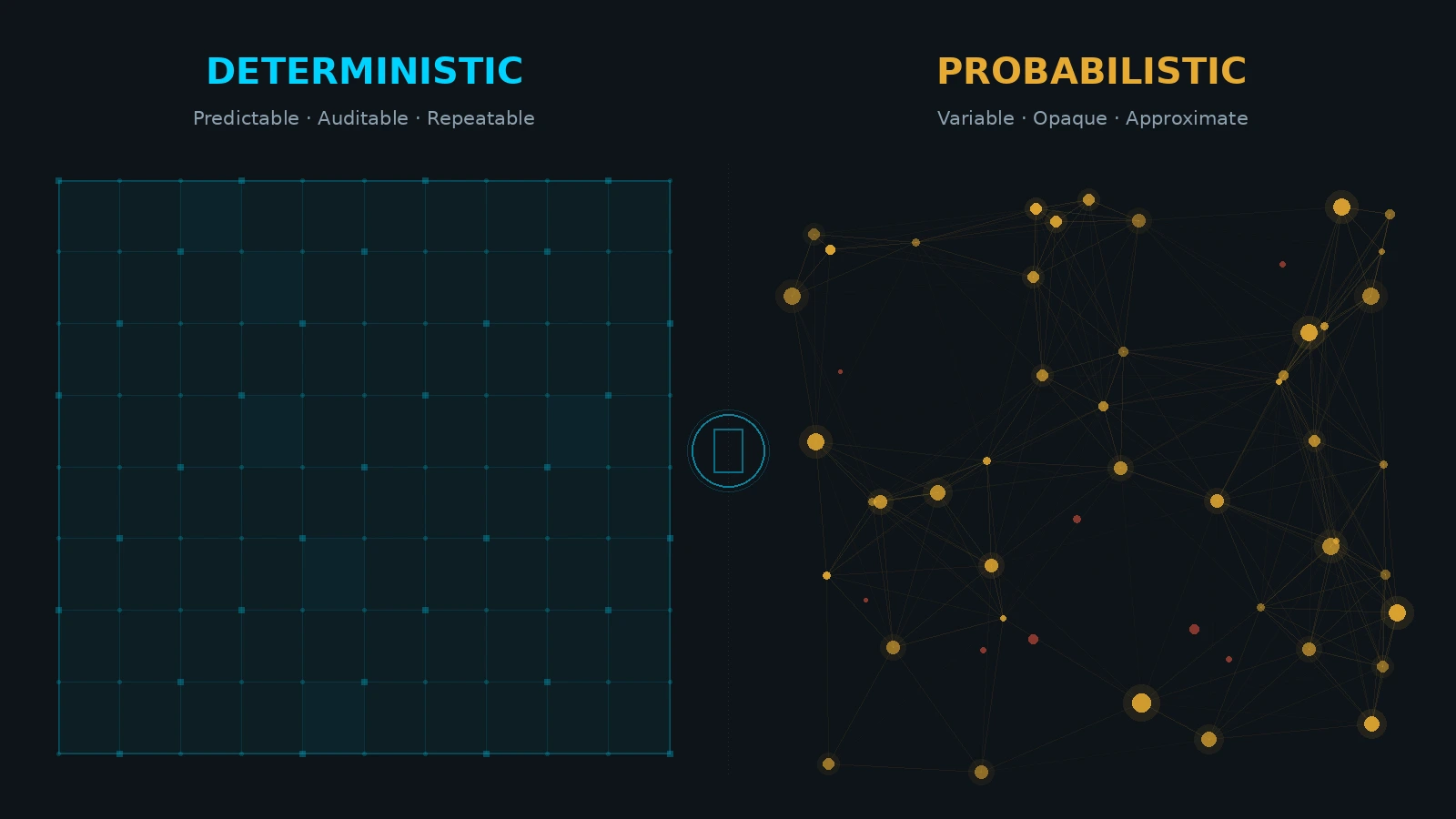
In the rush to adopt Artificial Intelligence, the technology sector has blurred the lines between two very different types of software: Probabilistic and Deterministic. Understanding the difference is critical for any Principal choosing a strata platform in 2026.
Probabilistic AI: The “Creative” Assistant
Large Language Models (like ChatGPT) are probabilistic. They predict the next word in a sentence based on probability. They are brilliant at drafting emails, summarising long documents, or suggesting wording for a motion.
This is where StrataPort uses AI — in the “Intake” and “Drafting” layers of our Operational Shield.
Deterministic Automation: The “Iron” Law
However, you cannot use probability to calculate a levy notice. You cannot use a “best guess” to reconcile a trust account. These tasks require Deterministic Automation.
Deterministic software follows rigid, “If This, Then That” logic. It produces the same result 100% of the time.
Deterministic Rules in Action
Why StrataPort Keeps Them Separate
In StrataPort we have deliberately firewalled our automation engine from our AI engine. When StrataPort runs a Daily Bank Reconciliation, it isn’t “thinking”; it is executing a mathematical proof. When it generates a Management Contract renewal, it isn’t “writing”; it is assembling validated data points.
Two Engines, One Platform
The Compliance Imperative
The Owners Corporations Act doesn’t allow for “hallucinations.” If an AI guesses a levy amount wrong, you are liable. That is why StrataPort’s core workflows — financials, compliance, and meeting generation — remain strictly deterministic. We use AI to help you read and write, but we use hard code to help you calculate and comply.
The future of strata software isn’t about choosing between AI and Rules. It’s about knowing where to apply them. StrataPort gives you the creativity of AI where you need it, and the certainty of Deterministic Automation where you demand it.